Overview
I study how occupational status hierarchies shape the coordination of expertise and innovation in firms during periods of strategic transition. Coordinating expertise across occupational groups is necessary for the success of modern firms—and for the development of the most consequential technologies of our moment, from generative AI to nuclear fusion. But status hierarchies are not fixed: when a firm changes what it does—when it moves from discovery to growth, pivots its product, or prepares to go public—the expertise it needs changes, and the standing of the occupational groups that hold that expertise changes with it.
My research program focuses on understanding the processes and mechanisms that shape effective expertise coordination and innovation in organizations whose business models rely on significant technological or scientific advances that are not yet commercialized (such as deep-tech firms and university basic science and engineering labs). The need to make novel technological breakthroughs before going to market imposes two salient constraints that dictate how these deep-tech firms operate: fundamental technology and commercialization risks, and substantial capital requirements.
To succeed, early-stage deep-tech firms hire and empower high-status technical experts—typically scientists and engineers with PhDs—and give them the resources and autonomy to experiment and develop novel technologies. However, these firms must eventually mature and function more like conventional businesses, reining in the very experts they previously empowered. During these strategic transitions, organizational expertise and needs are changing—and as they shift, occupational status hierarchies within the organization often shift as well. This contrasts with the typical model in previous research, which implicitly assumed organizations had agreed-upon occupational status hierarchies.
Dissertation
Alternating Currents: Occupational Status Hierarchies, Expertise Coordination, and Strategic Transitions
Finalist, 2026 INFORMS/Organization Science Best Dissertation Proposal Competition
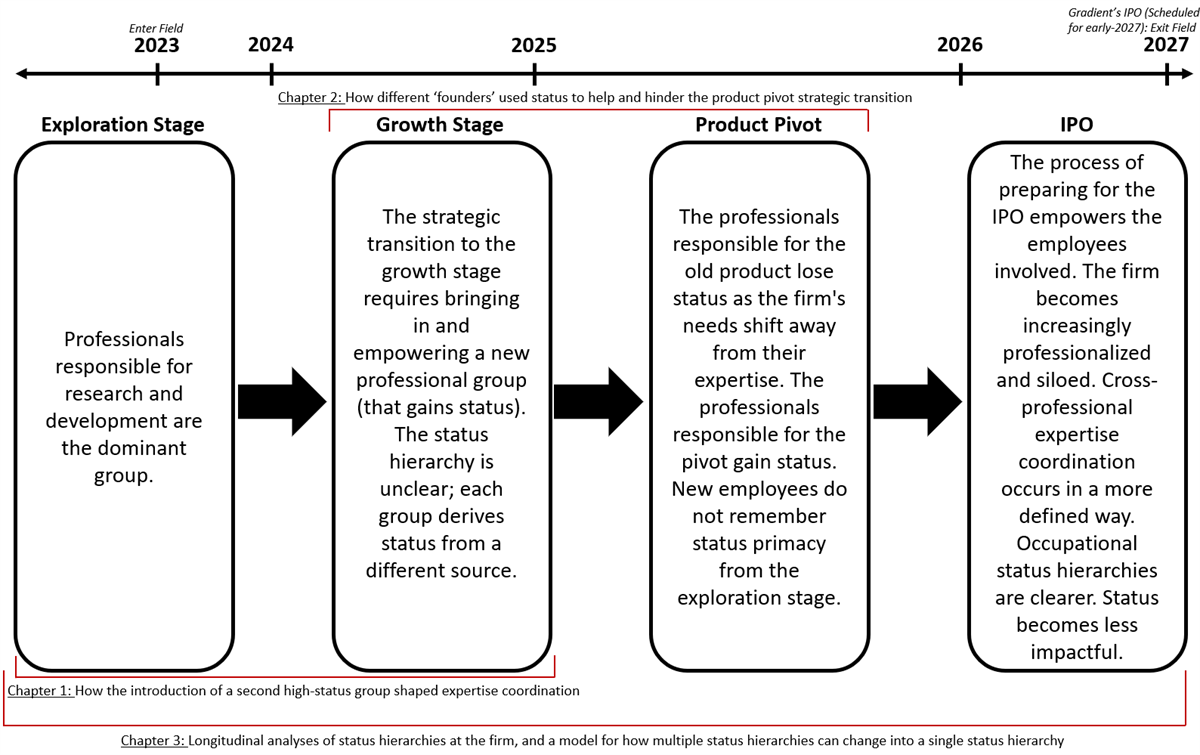
My dissertation examines how occupational status hierarchies shape the coordination of expertise and innovation in firms during periods of strategic transition. Using four years of ethnographic data (more than 1,600 hours of observation and 300 interviews, from the firm’s pre-revenue stage through its IPO process), it follows Gradient (a pseudonym), a multibillion-dollar deep-tech battery startup, through three strategic transitions—from scientific discovery to growth, a product pivot to support the AI data center boom, and a forthcoming IPO—to explore how these transitions reshape occupational status hierarchies and expertise coordination within an organization, and the consequences for firm strategy and innovation.
Alternating Currents argues that as organizational needs change, multiple orderings of status can arise. I develop a dynamic model of how these hierarchies emerge, diverge into multiple coexisting hierarchies with different sources of status, and ultimately converge—and I trace how these shifts affect expertise coordination and shape the organization’s strategic transitions.
I went to the office like a regular employee, Monday through Thursday, for five months, and have collected longitudinal data one to two days per week ever since.
Job Market Paper
“Suits and Lab Coats: Epistemic Privileging and Its Impact on Strategic Transition in a ‘Deep-Tech’ Battery Startup”
Under review · Finalist, Best Student-Led Paper, Kauffman Best Paper Awards in Entrepreneurial Cognition, Academy of Management (MOC Division), 2024
This paper begins from a puzzling observation during Gradient’s strategic transition to the growth stage: the firm’s high-status battery scientists began micromanaging and seeking control over marketing, public relations, and event-planning tasks outside their expertise and job responsibilities—tasks that prior scholarship suggests they would avoid. Gradient’s CTO, for example, line-edited a press release to be “technically correct” by replacing the word “battery” with “cell,” a change that caused a major investor to ask, “Are you a biotech company now?!” We theorize this pattern as epistemic privileging: a process in which high-status technical experts systematically disregard more relevant expertise from outside their group to protect their reputation among peers beyond the firm.
Epistemic privileging unfolds in three phases—task sanctification, technocratic overreach, and overriding expertise—and it impeded the strategic transition at Gradient in three ways: it damaged employee morale, it shaped decisions such as battery pricing to favor the technical experts’ reputational priorities over the firm’s goals, and it delayed task execution. For deep-tech firms like Gradient, which run significant operating deficits funded by impatient venture capital investors, such delays are an existential threat.
Remaining Dissertation Chapters
My dissertation includes two further papers, both solo-authored and in preparation.
“Founder Mode as a ‘Cultural Anchor’: Understanding How Startup Culture and Processes of Authority Attenuate the Negative Impacts of Micromanagement by Founders and Senior Technical Employees”
In preparation · Presented at the Academy of Management Annual Meeting (2025) and the Berkeley Culture Connect Conference (2026)
This paper investigates how Gradient’s executives, with varying effectiveness, used their status and cultural positionality as ‘founders’ to shape employees’ responses to the firm’s product pivot.
“Direct Current: A Dynamic Model of How Occupational Status Hierarchies Emerge, Diverge, and Converge”
In preparation
The final empirical chapter of my dissertation examines Gradient’s occupational status hierarchies longitudinally. At the time of “Suits and Lab Coats,” the battery group had enough status within the firm to bend the firm’s corporate communication strategy toward their reputational priorities. By the time Gradient began its IPO process, the firm had a completely different business model, had dramatically scaled back investments in next-generation battery R&D, and refused to discuss its battery chemistry and environmental goals for fear of spooking investors. All of these changes were made despite the battery group’s strenuous objections and required the firm to fire many of its battery employees and its CTO. I aim to explain these dramatic shifts with a generalizable process model of changing occupational status hierarchies and sources of status.
A practitioner article drawn from this work, “Shifting Currents: Deep-Tech Firms and Strategic Transitions” (with Arvind Karunakaran), is under review.
How Expertise Is Evaluated Beyond the Firm
A related line of work asks the same question outside the firm: whose voice and expertise count. Inside Gradient, status determines whose expertise counts; beyond it, the same contest plays out between experts, intermediaries (e.g., media organizations, influencers, and algorithmically curated platforms), and the public—dynamics that speak to what scholars are calling the ‘crisis of expertise.’ This stream also includes my chapter in Research in the Sociology of Organizations (see Publications below).
“Expert Authority by Popularity: How Technological Developments and Changes in the Media Have Given Rise to a Novel Mechanism for Evaluating Expertise”
Under review
This paper theorizes how technological developments and changes in the media have given rise to a novel, popularity-based mechanism for evaluating expertise. We argue that, for some audiences, the typical relationship between audience and expert authority has inverted: rather than expert authority attracting an audience, audiences can become the source of expert authority.
Research Design
My dissertation data is valuable not just because of the hours I spent in the field, but because I combine longitudinal ethnographic data from pre-revenue through IPO with access to influential external stakeholders, including Gradient’s investment bank and PR firm, as well as other players in the energy-tech ecosystem. This attention to research design extends to a paper on participant pseudonymity in the age of AI.
“Participant Pseudonymity in the Age of AI”
Under review
This paper examines an emerging issue in research design—LLMs can now cheaply and reliably de-pseudonymize partner organizations in management research and case studies—and recommends changing field practices around required disclosures and transparency.
Future Research
Beyond the three empirical chapters of my dissertation, I plan to draw on my parallel fieldwork at Gradient and at its investment bank to explore the impact of what the firm’s CMO called “a massive disconnect between what we are going to raise money on vs. what the vast majority of this company is doing.”
For my next empirical project, I intend to go deeper into the intersection of status, expertise, and technology development. One future direction is to understand how, in uncertain information environments, founders gain status and demonstrate expertise through performing cultural archetypes. I am in talks with the young founder of an AI decacorn to conduct an open-ended ethnography exploring his embodiment of several influential Silicon Valley tropes and his desire for, and the process of, “birthing a god.”
Publications
Benjamin-Pollak, N.A., & Karunakaran, A. (2025). “Expert authority and the public sphere: Media intermediaries, professional norm violation, and the market for expertise.” In K. T. Elmholdt, R. Huising, & E. I. Mäkinen (Eds.), Expertise in and around organizations: The changing constitution and ecology of expertise (Research in the Sociology of Organizations, Vol. 97, pp. 249–269). Emerald Publishing. Open access.
This chapter develops a model of expert amplification, showing how professional norms and media intermediaries skew which experts are selected and represented to the public—in ways uncorrelated with underlying expert quality.